Showing posts with label Watchlist. Show all posts

Friday, January 27, 2012

Undergrad Origins of Ph.D.s

Ace! NewsFlash 


What schools produce the most undergraduates who end up heading off to graduate school?
The subject came up yesterday because a friend of mine was telling me about a brilliant teenager who wants to eventually get a PhD in physics. The student lives in California, but the mom wants him to apply to schools in the Midwest where she grew up.
I asked my friend if the teenager had checked out Lawrence University.
“Huh?”
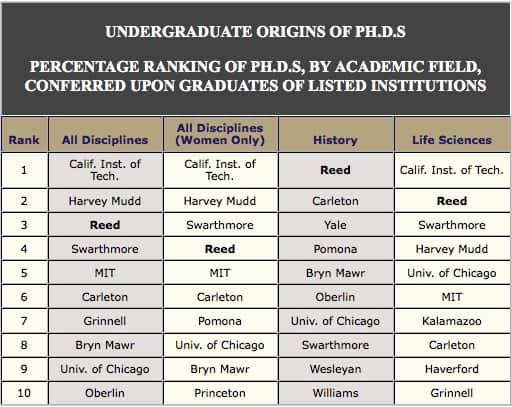
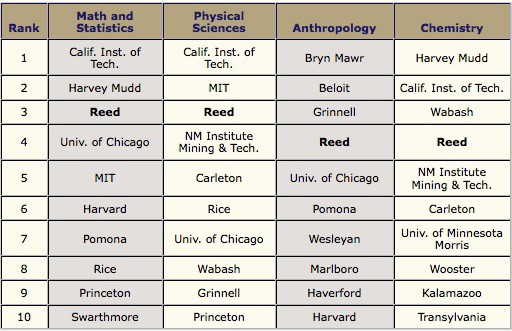
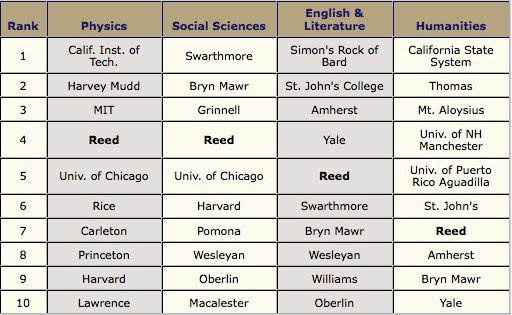
I realize that might be your reaction, but here’s the thing – many of the schools that are feeder institutions for the nation’s PhD programs are liberal arts colleges. While most liberal arts colleges are not well-known among families with teenagers, these institutions — and their reputations — are very well known to graduate schools. Lawrence University, a liberal arts college Appleton, WI, for instance, happens to be 10th on the list among all four-year colleges and universities that produce, per capita, the most physics PhDs. (See chart below.)

PhD Feeder Schools

I bet most families assume that attending a public flagship university or a nationally-known private research university is the best ticket to graduate school. If you look at the following lists of the most successful PhD feeder schools for different majors, you will see a somewhat different story. Not a single public university makes any of the lists. The entire Cal State system, however, is considered the No. 1 producer of humanities PhD’s.
I thought you’d be interested in the list of undergraduate institutions that, per capita, produce the most PhD’s. I pulled the names off the website of  Reed College, a liberal arts college in Portland, OR, that is understandably proud of its impressive record of turning out undergrads who end up earning PhD’s. The statistics cover the years 1997 to 2006 and come from the National Science Foundation and the federal government’s education database.
On the list of schools that have the most undergrads who ultimately earn a PhD  in all disciplines, Reed comes in No. 3 behind Cal Tech and Harvey Mudd College.
As you’ll see in the first column below, seven of the 10 schools, whose graduates earn the most PhD’s by the percentage of students are liberal arts colleges.


Bottom Line:

Students can increase their odds of being accepted to graduate school if they earn their bachelor’s degree at a liberal arts college. On a per capita basis, for instance, liberal arts colleges produce twice as many students who earn a PhD in science than other institutions. That makes sense since students have more opportunities to work closely with their professors, they can actually learn more due to small classes and receive glowing recommendations from their teachers, many of which, graduated from prestigious graduate programs.
What’s even more remarkable about the prominence of liberal arts colleges on the science lists is this: many students major in other disciplines at liberal colleges while students who attend schools like Cal Tech and MIT overwhelmingly expect to pursue careers in the sciences and engineering.
I’ve attached a lengthy essay by Thomas R. Cech, a Grinnell College grad, Nobel Laureate and chemistry professor at the University of Colorado, who wrote a fascinating essay contrasting the science experience for undergrads at colleges versus universities. Cech believes science majors at liberal arts colleges enjoy an advantage over undergrads who attend universities. Here are Cech’s thoughts:  Science at Liberal Arts Colleges: A Better Education?
Lynn O’Shaughnessy is the author of The College Solution, an Amazon bestseller, and a workbook,Shrinking the Cost of College

collegesolutions.com, Jan 2012

 *** Ace! is a member of the EducationUSA global educational advising network affiliated with the Bureau of Educational and Cultural Affairs, U.S. Department of State. We provide free EducationUSA counseling services to students in the northern provinces of Thailand; our faculty of U.S.-trained Test Prep Experts can help you with cost-effective result-driven training programs for SAT-1, SAT-2, TOEFL, GRE, GMAT, GED, AP, IB, TOEIC, IELTS etc http://acethai.weebly.com ***

Saturday, December 24, 2011

Hot New Jobs for Today's College Grads

Ace! NewsFlash 


In a tough economy like this one, it's easy to get caught up in the negativity.  It's true, the unemployment rate for recent graduates is high and the average amount of debt per student is growing.  Despite these sobering statistics, there are several newly created career paths that just may be a perfect fit for you.  Many of these jobs are so new that most colleges don't offer a major for them yet, meaning they're fair game for just about anyone!
1. Paid Blogger - As companies are realizing the benefits of having an active presence online, many have started hiring freelance or salaried company bloggers.  Just about anyone with a stellar writing portfolio could qualify, but it may help if you have some experience or connection with the company's industry.  I got my job as the editor at Uloop's blog because I started a community blog at my college last year.
Suggested Majors: English, Communications, Marketing, Public Relations
Other Requirements: Start a personal blog and keep it very focused on the industry you want to work in.  Also, start contributing to other blogs.  You'll probably need to write 2 to 7 articles per week in order to get your blog noticed, and show people you're serious.
2. Social Media Manager/Strategist - Over 59% of the Fortune 100 companies have dedicated a special part of their PR firm to managing and monitoring social media accounts, but that number is expected to rise quickly in the coming years.  Much like paid bloggers, social media managers help project a company's image online by keeping up with engagement on Facebook, Twitter, and Google+.  Some of these jobs also involve more technical work, like creating Facebook apps or integrating social networks with the company's website.
Suggested Majors: Public Relations, Communications, Information Technology, Marketing, Statistics
Other Requirements: For many companies, Klout score has become the de facto standard for measuring influence on social networks.  Make sure all your social media accounts are squeeky clean and open to the public, then focus your content on the industry you're interested in.  Post at least 3-5 times per day on Twitter and 1-2 on Facebook, but the most important part is engaging with people in the industry you're pursuing.  You never know who you'll meet by actively networking online!
3. User Experience Designer - Companies are paying more attention to design and user experience than ever before.  While this job can be web or software based, it doesn't have to be.  Experts in user experience have to have a firm attention to detail, an eye for design, and familiarity with the consumer's mindset.
Suggested Majors: Psychology, Retail Studies, Fashion Design, Marketing, Graphic Design, Architecture, Industrial Design, Information Technology
Other Requirements: Having a design or concepts portfolio will be your biggest advantage in this field.  Start getting familiar with Photoshop or some CAD programs that are relevant to your industry.  Read (and maybe write your own) case studies about consumer behavior and spending, and build a portfolio.
4. 3-D Graphics Designer - Ever since America fell in love with Pixar's Toy Story, 3-D design has become a huge part of the film industry.  Video games have also become a big business as products like the X-Box Kinect and Nintendo Wii are bringing gaming to a more mainstream audience.  Other companies need 3-D and motion graphics designers for advertisements, websites, or marketing material.  You'll need a little bit of training, so if your school doesn't offer it, I suggest finding a course or two online.
Suggested Majors: Graphic Design, Advertising, Film Studies, Marketing, Computer Science, Information Technology, Art
Other Requirements: As always, companies would rather hire a graduate with established experience than train someone fresh.  Start reading into the tools that major players in the industry use, and see if you can invest in a discounted student version.  Once you get familiar with them, build a portfolio.  Going into an interview with a handful of completed projects is a sure-fire way to set yourself apart.
5. Sustainability Consultant - As the government becomes more aware of the harmful effects that heavy metals and CO2 can have on our planet, they have tightened regulation and sanctions on companies who use or process harmful chemicals.  Knowing this, many companies have started to realize that green sells, so they try to go the extra mile to provide products that are as environmentally safe as possible.  Cutting electricity use, switching to new paints or dyes, constructing efficient buildings, and minimizing fuel consumption can both save a company money and help protect the environment, but many companies don't know where to start.  Sustainability consultants are experts (usually in a certain field) in helping companies become more eco-friendly.
Suggested Majors: Chemistry, Engineering, Political Science (or Pre-Law), Environmental Studies, Economics
Other Requirements: Take some extra classes on environmental policy and environmental science if you can.  Familiarizing yourself with both the science and the law as well as the basic economics of saving energy will help you be more prepared for an interview.  Find out if there are any licenses or certifications that you can get in your state as this may be a requirement for some jobs in sustainability.
6. Patient Advocate - New policies in the medical industry in the past 10-15 years have increased patients' rights when visiting the doctor.  Patient advocates are familiar with the policy and common practice at clinics and hospitals and make sure that communication between the doctor, nurses, patient, and insurance company is clearly understood.  Often times, family members of a sick or dying person are unable (or too overwhelmed) to take care of the day-to-day work involved in filing bills, negotiating with insurance, calling doctors, and filling prescriptions, so Patient Advocates can be ahuge help in their time of need.
Suggested Majors: Nursing, Pre-Medical, Communications, Social Work, Sociology, Psychology
Other Requirements: Some experience in the medical field will likely be required.  Volunteering at a local hospital or nursing home may be a great way to see first-hand how things work without needing prior experience.  You'll also want to make sure you're up for this kind of work because you'll spend a lot of your time around sick and dying people.  While knowing that you're making a difference in their quality of life is comforting, some people may find the work environment depressing.


huffpost 12/12/11

 *** Ace! is a member of the EducationUSA global educational advising network affiliated with the Bureau of Educational and Cultural Affairs, U.S. Department of State. We provide free EducationUSA counseling services to students in the northern provinces of Thailand; our faculty of U.S.-trained Test Prep Experts can help you with cost-effective result-driven training programs for SAT-1, SAT-2, TOEFL, GRE, GMAT, GED, AP, IB, TOEIC, IELTS etc http://acethai.weebly.com ***

Tuesday, September 6, 2011

Jeffrey Sachs & Happiness Econ 101

Ace! NewsFlash

Jeffrey D. Sachs

NEW YORK – We live in a time of high anxiety. Despite the world’s unprecedented total wealth, there is vast insecurity, unrest, and dissatisfaction. In the United States, a large majority of Americans believe that the country is “on the wrong track.” Pessimism has soared. The same is true in many other places.

Against this backdrop, the time has come to reconsider the basic sources of happiness in our economic life. The relentless pursuit of higher income is leading to unprecedented inequality and anxiety, rather than to greater happiness and life satisfaction. Economic progress is important and can greatly improve the quality of life, but only if it is pursued in line with other goals.

In this respect, the Himalayan Kingdom of Bhutan has been leading the way. Forty years ago, Bhutan’s fourth king, young and newly installed, made a remarkable choice: Bhutan should pursue “gross national happiness” rather than gross national product. Since then, the country has been experimenting with an alternative, holistic approach to development that emphasizes not only economic growth, but also culture, mental health, compassion, and community.

Dozens of experts recently gathered in Bhutan’s capital, Thimphu, to take stock of the country’s record. I was co-host with Bhutan’s prime minister, Jigme Thinley, a leader in sustainable development and a great champion of the concept of “GNH.” We assembled in the wake of a declaration in July by the United Nations General Assembly calling on countries to examine how national policies can promote happiness in their societies.

All who gathered in Thimphu agreed on the importance of pursuing happiness rather than pursuing national income. The question we examined is how to achieve happiness in a world that is characterized by rapid urbanization, mass media, global capitalism, and environmental degradation. How can our economic life be re-ordered to recreate a sense of community, trust, and environmental sustainability?

Here are some of the initial conclusions. First, we should not denigrate the value of economic progress. When people are hungry, deprived of basic needs such as clean water, health care, and education, and without meaningful employment, they suffer. Economic development that alleviates poverty is a vital step in boosting happiness.

Second, relentless pursuit of GNP to the exclusion of other goals is also no path to happiness. In the US, GNP has risen sharply in the past 40 years, but happiness has not. Instead, single-minded pursuit of GNP has led to great inequalities of wealth and power, fueled the growth of a vast underclass, trapped millions of children in poverty, and caused serious environmental degradation.

Third, happiness is achieved through a balanced approach to life by both individuals and societies. As individuals, we are unhappy if we are denied our basic material needs, but we are also unhappy if the pursuit of higher incomes replaces our focus on family, friends, community, compassion, and maintaining internal balance. As a society, it is one thing to organize economic policies to keep living standards on the rise, but quite another to subordinate all of society’s values to the pursuit of profit.

Yet politics in the US has increasingly allowed corporate profits to dominate all other aspirations: fairness, justice, trust, physical and mental health, and environmental sustainability. Corporate campaign contributions increasingly undermine the democratic process, with the blessing of the US Supreme Court.

Fourth, global capitalism presents many direct threats to happiness. It is destroying the natural environment through climate change and other kinds of pollution, while a relentless stream of oil-industry propaganda keeps many people ignorant of this. It is weakening social trust and mental stability, with the prevalence of clinical depression apparently on the rise. The mass media have become outlets for corporate “messaging,” much of it overtly anti-scientific, and Americans suffer from an increasing range of consumer addictions.

Consider how the fast-food industry uses oils, fats, sugar, and other addictive ingredients to create unhealthy dependency on foods that contribute to obesity. One-third of all Americans are now obese. The rest of the world will eventually follow unless countries restrict dangerous corporate practices, including advertising unhealthy and addictive foods to young children.

The problem is not just foods. Mass advertising is contributing to many other consumer addictions that imply large public-health costs, including excessive TV watching, gambling, drug use, cigarette smoking, and alcoholism.

Fifth, to promote happiness, we must identify the many factors other than GNP that can raise or lower society’s well-being. Most countries invest to measure GNP, but spend little to identify the sources of poor health (like fast foods and excessive TV watching), declining social trust, and environmental degradation. Once we understand these factors, we can act.

The mad pursuit of corporate profits is threatening us all. To be sure, we should support economic growth and development, but only in a broader context: one that promotes environmental sustainability and the values of compassion and honesty that are required for social trust. The search for happiness should not be confined to the beautiful mountain kingdom of Bhutan.

Jeffrey D. Sachs is Professor of Economics and Director of the Earth Institute at Columbia University. He is also Special Adviser to United Nations Secretary-General on the Millennium Development Goals.


*** Ace! is a member of the EducationUSA global educational advising network affiliated with the Bureau of Educational and Cultural Affairs, U.S. Department of State. We provide free EducationUSA counseling services to students in the northern provinces of Thailand; our faculty of U.S.-trained Test Prep Experts can help you with cost-effective result-driven training programs for SAT-1, SAT-2, TOEFL, GRE, GMAT, GED, AP, IB, TOEIC, IELTS etc http://acethai.weebly.com ***