Showing posts with label U.S. culture/lifestyle. Show all posts

Saturday, March 17, 2012

"Stop obsessing on rankings. Don’t share all details of college apps"

Ace! NewsFlash 


Admissions Expert Offers Tips On Getting Into College
Reed College, a member of Colleges that Change Lives. Photo courtesy of CTCL
College acceptance letters will be arriving soon, followed by the inevitable news stories about the students with the perfect grades and resumes who didn’t get into their top choices.
And that will only amp up the stress and worry of those parents and kids who are already freaking out about the tiny acceptance rates of the best colleges as defined by the annual U.S. News and World Report rankings.
“In less than three weeks, you will begin to get an idea about college admissions that is not the way it is,” admissions expert Martha O’Connell told a couple hundred parents and students who gathered Tuesday night in the cafeteria of Bethesda-Chevy Chase High School. “The problem is those stories don’t tell the whole truth. The reality is far different.”
“The reality is that the average admissions rate at four-year colleges and universities is close to 70 percent,” said O’Connell, the executive director of Colleges that Change Lives, a nonprofit organization dedicated to the advancement and support of a student-centered college search process.  In fact, fewer than 100 schools reject more students than they admit.
That was one of the key messages that O’Connell delivered during a PTSA-sponsored talk on choosing the right college. The session drew parents from Walter Johnson and Walt Whitman high schools and other Montgomery County public schools as well.
O’Connell, who spent 30 years working in college admissions, told parents and students to stop obsessing on rankings that focus on a college’s applicant pool, but don’t say much about what the school offers students.
“We are driven by name brand. We love what we know about,” she said. “This process works best when it starts with the student. You are not a refrigerator. You are not a car. Those things are easy to rank. There’s no direct way to measure the quality of an institution.”
“I say this to get you to be a careful and considerate consumer,” she said. “So look at the numbers and what they really mean.”
Most importantly, students should drive the search process, asking whether prospective schools offer the culture and learning environment that will make them happy and successful. And they can only discover that by researching those schools and asking questions during college fairs and campus visits, O’Connell said.
To get a sense of a school’s culture, check out its website. If it features lots of news about sports teams or politics, then that’s probably what important to the school. And when visiting campuses, make sure to go during the busiest class time to see how students act and how they dress, and to listen to what they talk about—all of which also will tell a lot about a school’s culture.
Some other helpful tips:
Set up an email address just for the application process. Some schools will communicate only by email and important messages could be missed in the flood coming into your regular account.
Start making contacts at schools that you’re interested in. That means filling out online prospect cards and info cards at college fairs, and making sure to let schools know when you stop by to visit or emailing them after. Go to the admissions tab on the school’s website and find out who is the admissions officer for your area and email that person about your interest.
“They’re the person who’s going to be reading your application,” O’Connell says, noting that contacts can be the deciding factor for an admissions officer. “I’m going to admit the person who has a lot of contacts because they’re interested and they’re probably going to enroll.”
Schedule a specific time each week to talk about how the application process is going. That will help reduce the stress on students who can get overwhelmed by the nagging of worried parents. O’Connell says her family chose Sunday nights and met for just one hour each week.
“It created a time and a place for it and I guarantee it makes for a happier household,” she said.
And finally, don’t share all the details of the application process with everyone. That way, there’s less to deal with if things don’t work out.
“If you can resist the urge to share a lot about the process, it will make it easier for you,” O’Connell advised.

Mar 16, 2012 - 12:08 PM  bethesdamag.com


 *** Ace! is a member of the EducationUSA global educational advising network affiliated with the Bureau of Educational and Cultural Affairs, U.S. Department of State. We provide free EducationUSA counseling services to students in the northern provinces of Thailand; our faculty of U.S.-trained Test Prep Experts can help you with cost-effective result-driven training programs for SAT-1, SAT-2, TOEFL, GRE, GMAT, GED, AP, IB, TOEIC, IELTS etc http://acethai.weebly.com ***

Tuesday, February 28, 2012

Viewbook...Spaceship...William & Mary!

Ace! NewsFlash 

When the College of William & Mary admission staff decided to redesign the brochure it mails to prospective students, they wanted something different. Something eye-catching, memorable. Something high- schoolers wouldn’t throw away.
”We wanted people to open the mailbox and say, ‘Viewbook... viewbook... viewbook... spaceship!’” said Dean of Admission Henry R. Broaddus.

(Photos by Jenna Johnson (The Washington Post))
Their final product: The Ampersandbox, a thin cardboard box filled with 15 heavy-weight cards. On the front of the cards, the school plays off its signature conjunction with bold two-word statements (like “Down & Dirty” or “Ebb & Flow”) on top of a photo. The back of the cards feature meaty information like lists of student clubs, study abroad options, research opportunities and academic majors. (There’s also an Ampersandbox online, where users can shift through the university’s collection of word pairs and create their own.)
As I talk with college admissions officials, I keep hearing about their attempts to move away from “three and tree” — brochures that prominently feature a photo of three diverse students studying under a tree on a gorgeous sunny day. The universal thinking seems to be that today’s college-bound teens want something that stands out in the mailbox, that speaks to them without using marketing-speak and that points them to an interactive online feature.

Many of the viewbooks that land in my mailbox look more like a coffee table book or magazine than a brochure. With their funky photos, edgy design, unusual color palates and one-word headlines, these viewbooks look like something you might find on a bookshelf at Urban Outfitters.

The University of Maryland, Baltimore County, just published comic-book-style brochures and a Web site that features students dressed as superheroes. American University, which branded itself as being a home to “wonks,” hands out artsy seven-by-seven-inch square books. Flipping through the viewbook for Loyola University Maryland is like reading a well-designed teen magazine that plots dry statistics and facts on colorful graphics.
In William and Mary’s deck of cards, the language is casual, inside-ish and a little nerdy. For example, a card labeled “Home & Away” features a photo from move-in day and reads, in part: “At some point during your second week at William & Mary, you’re going to be at the IHOP with some hall-mates... and you’re going to say it. ‘Let’s go home.’ You won’t be referring to your parents’ split-level ranch in Bethesda. You’ll be talking about Barrett, where you and a stranger from Idaho (now your second-best friend) share 345 square feet of barely contained chaos.”

“The voice on those cards is very strong. It’s authentic,” Broaddus said. As staffers edited some of the cards, they wondered, “Is it too inside? I don’t think so. I think we pulled that off.”
The most talked-about card in the pack (at least in our office) is labeled “Naked & Friendly” and features a photo of the school’s mascot, The Griffin, who appears to be giggling. The Griffin was once criticized by W&M alum Jon Stewart on the Daily Show for not wearing any pants. While some schools might be offended by such a slam, William and Mary promises students that at August move-in they will be “greeted by a pants-less Griffin.”
“Jon Stewart, being an alum. We can’t claim that often enough,” Broaddus said.

Posted at 02:25 PM ET, 02/27/2012, wp.com


 *** Ace! is a member of the EducationUSA global educational advising network affiliated with the Bureau of Educational and Cultural Affairs, U.S. Department of State. We provide free EducationUSA counseling services to students in the northern provinces of Thailand; our faculty of U.S.-trained Test Prep Experts can help you with cost-effective result-driven training programs for SAT-1, SAT-2, TOEFL, GRE, GMAT, GED, AP, IB, TOEIC, IELTS etc http://acethai.weebly.com ***

Sunday, February 5, 2012

SF: World's Best "City By The Bay"

Ace! NewsFlash 

A new video showcases San Francisco at its finest, bringing viewers along for a three-and-a-half minute adventure through the staples, from a bike ride along the Golden Gate Bridge and a romp through the park to dinner at the finest restaurants and a night out on the town.


Go ahead, fall in love with SF all over again!

 *** Ace! is a member of the EducationUSA global educational advising network affiliated with the Bureau of Educational and Cultural Affairs, U.S. Department of State. We provide free EducationUSA counseling services to students in the northern provinces of Thailand; our faculty of U.S.-trained Test Prep Experts can help you with cost-effective result-driven training programs for SAT-1, SAT-2, TOEFL, GRE, GMAT, GED, AP, IB, TOEIC, IELTS etc http://acethai.weebly.com ***

Thursday, February 2, 2012

The Liberal Arts as Guideposts in the 21st Century

Ace! NewsFlash


The very broad, capacious form of education that we call the liberal arts is rooted in a specific curriculum in classical and medieval times. But it would be wrong to assume that because it has such ancient roots, this kind of education is outdated, stale, fusty, or irrelevant. In fact, quite the contrary. A liberal-arts education, which Louis Menand defined in The Marketplace of Ideas as "a background mentality, a way of thinking, a kind of intellectual DNA that informs work in every specialized area of inquiry," lends itself particularly well to contemporary high-tech methods of imparting knowledge.
We all wrestle with the challenges of educating students who are used to multitasking, doing their homework while listening to music and texting on their iPhones. For such students, the Web-based facilities of exciting liberal-arts courses are particularly salient. What would Aristotle or Erasmus or Robert Maynard Hutchins not have given for a technique that allows one to tour the world's greatest museums, looking closely at the details of countless masterpieces; explore the ruins of ancient castles and pyramids and forums; join archaeological digs at your desk, turning objects around to see all sides of them; visualize problems in geometry or astronomy or mathematics in several dimensions and work out their solutions.
An excellent example of the power of multimedia coupled with the liberal arts is "Imaginary Journeys," a general-education course sometimes taught at Harvard University by Stephen Greenblatt. The course is described as being "about global mobility, encounter, and exchange at the time that Harvard College was founded in 1636. Using the interactive resources of computer technology, we follow imaginary voyages of three ships that leave England in 1633. Sites include London's Globe Theatre, Benin, Barbados, Brazil, Mexico." With this kind of course in mind, it seems that the liberal arts could almost have been designed for sophisticated online learning, so far from being stale or fusty are these ways of knowing.
This kind of education has become more and more appealing to students and teachers at universities around the world. Donald Markwell, the warden of Oxford's Rhodes House, recently gave a series of lectures in Canada entitled "The Need for Breadth." He referred to a "surge of interest" in liberal education in "many other countries." He cites a major address in London by Yale's Richard Levin in which Levin noted that "Asian leaders are increasingly attracted to the American model of undergraduate curriculum," specifically because of the two years of breadth and depth in different disciplines provided before a student chooses an area of concentration or embarks on professional training. Levin described liberal-arts honors programs at Peking University, South Korea's Yonsei University, and the National University of Singapore; he also referred to liberal-arts curricula at Fudan University, Nanjing University, and the University of Hong Kong.
Yet, as we know, the trends in the United States are in the opposite direction, and this is not just a recent problem. Menand cites evidence that in the United States, "the proportion of undergraduate degrees awarded annually in the liberal arts and sciences has been declining for a hundred years, apart from a brief rise between 1955 and 1970, which was a period of rapidly increasing enrollments and national economic growth." Thus, paradoxically, as a liberal-arts education becomes more appealing to leaders and families in Asia and elsewhere in the world, it is losing ground in our own country.
At least three factors are at work in this decline: a) the creation of increasingly specialized disciplines, and the rewards for faculty members for advancing knowledge in those areas; b) the economic premium that is thought to reside in a highly technical form of preparation for careers; and c) a growing focus on graduate education from the early 20th century to the present day. These developments have clearly not been beneficial for American undergraduate education.
"Liberal education in crisis" is a tiresomely familiar theme, and countless commissions, reports, and study groups have attempted to address it. I am under no illusions that I have the magic key to resolve a problem that has stumped so many brilliant educators. But these are not just theoretical quandaries, they are the issues we confront almost every day: How do we defend liberal education against the skeptics—parents, potential students, the media, the marketplace, even some trustees and students?
The first, most practical defense is that the liberal arts (and sciences) are the best possible preparation for success in the learned professions—law, medicine, teaching—as well as in the less traditionally learned but increasingly arcane professions of business, finance, and high-tech innovation. So my first defense of liberal learning is what you are taught and the way you learn it: the materials a doctor or financial analyst or physicist or humanist needs to know, but taught in a liberally construed fashion, so that you look at the subject from many different dimensions and incorporate the material into your own thinking in ways that will be much more likely to stay with you, and help you later on.
This way of learning has several distinct advantages: It's insurance against obsolescence; in any rapidly changing field (and every field is changing rapidly these days), if you only focus on learning specific materials that are pertinent in 2012, rather than learning about them in a broader context, you will soon find that your training will have become valueless. Most important, with a liberal education you will have learned how to learn, so that you will be able to do research to answer questions in your field that will come up years from now, questions that nobody could even have envisioned in 2012, much less taught you how to answer.
The second, slightly less utilitarian defense of a liberal-arts education is that it hones the mind, teaching focus, critical thinking, and the ability to express oneself clearly both in writing and speaking—skills that are of great value no matter what profession you may choose. It's not just that you are taught specific materials in a liberally designed context, but more generally, the way your mind is shaped, the habits of thought that you develop.
These skills were well described by a former dean of the Harvard Law School, Erwin Griswold, cited in a recent speech by the current dean, Martha Minow. Griswold was discussing an ideal vision of the law school, but his arguments fit a liberal education wherever it is provided: "You go to a great school not so much for knowledge as for arts or habits; for the art of expression, for the art of entering quickly into another person's thoughts, for the art of assuming at a moment's notice a new intellectual position, for the habit of submitting to censure and refutation, for the art of indicating assent or dissent in graduated terms, for the habit of regarding minute points of accuracy, for the art of working out what is possible in a given time; for taste, for discrimination, for mental courage, and mental soberness."
My third argument is that a liberal-arts education is the best education for citizenship in a democracy like ours. In her book, Not for Profit, Martha Nussbaum points out that from the early years of our republic educators and leaders have "connected the liberal arts to the preparation of informed, independent, and sympathetic ... citizens." Nussbaum argues that democracies need "complete citizens who can think for themselves, criticize tradition, and understand the significance of another person's sufferings and achievements." Among the skills a liberal-arts education fosters, she notes, are the ability "to think about the good of the nation as a whole, not just that of one's local group," and "to see one's own nation, in turn, as part of a complicated world order." At a time when democracy is struggling to be born in countries around the world, and countries that have long enjoyed democracy are struggling to sustain it against pressures of multiple varieties, this may be the best of all the arguments for a liberal-arts education.
My fourth argument I borrow from Michel de Montaigne, who thought of his own mind as a kind of tower library to which he could retreat even when he was far from home, filled with quotations from wise people and experimental thoughts and jokes and anecdotes, where he could keep company with himself. In his essay "Of Solitude," he suggested that we all have such back rooms in our minds. The most valuable and attractive people we know are those who have rich and fascinating intellectual furniture in those spaces rather than a void between their ears.
Virginia Woolf used a different spatial image to make a similar point in her book Three Guineas, when she talked about the importance of cultivating taste and the knowledge of the arts and literature and music. She argues that people who are so caught up in their professions or business that they never have time to listen to music or look at pictures lose the sense of sight, the sense of sound, the sense of proportion. And she concludes: "What then remains of a human being who has lost sight, and sound, and a sense of proportion? Only a cripple in a cave." So my fourth argument for a liberal-arts education is that it allows you to furnish the back room of your mind, preparing you for both society and solitude.
My final argument is that the liberal arts admit you to a community of scholars, both professional and amateur, spanning the ages. Here I would quote one of my predecessors at Wellesley, Alice Freeman (later Alice Freeman Palmer). When she presided over Wellesley in the last part of the 19th century, it was quite unusual for girls to go to college (as indeed it still is today in some parts of the world). In a speech she gave to answer the repeated question she got from girls and their families, "Why Go to College?" she said: "We go to college to know, assured that knowledge is sweet and powerful, that a good education emancipates the mind and makes us citizens of the world." The sweet and powerful knowledge imparted by a liberal-arts education is specifically designed to fulfill this promise.
But how can college presidents today best go about making the case for the liberal arts? First and most obvious, they should use the bully pulpit of the college presidency deliberately and effectively—at convocations, commencements, groundbreakings for new buildings, in speeches to the local Rotary Club or the state 4-H club convention, and addresses to alumni clubs. This is a truly precious opportunity that few other leaders have, to address the community in situations where there is likely to be respectful attention to their message, at least for a while! They should use the opportunity with zest!
The second way is by using their fund-raising skills and obligations to raise money for exciting programs like Greenblatt's "Imaginary Journeys." They can make this case effectively to foundations and generous alumni who remember their own liberal-arts education fondly, and thus enhance the resources available for this purpose.
Presidents can demonstrate their support of the liberal arts in how they honor faculty members. With the teaching awards and other distinctions their colleges offer, they should single out for praise and support those who have been most effective in advancing the liberal-arts mission. And then they can ensure that these awards and recognitions are appropriately highlighted in college publications and in messages to parents and prospective students.
And perhaps the most effective way presidents can use their leadership to offer support is to speak from a liberal-arts perspective in their own discourse, both formal and informal, by citing examples of fine literature, drawing on instances from history, referring to the arts, and describing learning in the sciences in liberal terms. Rhetoric was one of the original artes liberales, and it can still be one of the most transformative.
Taking my own advice about larding language with liberal learning, I will conclude with a poem by Imam Al-Shafi'i, which I discovered in a brochure on a recent visit to the Georgetown University School of Foreign Service, in Doha, Qatar:
According to the measure of hardship are heights achieved,
And he who seeks loftiness must keep vigil by night;
As for he who wants heights without toil,
He wastes his life seeking the impossible—
So seek nobility now, then sleep once more (finally),
He who seeks pearls must dive into the sea.
As this poem reminds us, a liberal-arts education is not always easy; it involves paying close attention, taking risks, exploring uncharted territory, diving into the sea. But despite these challenges, the deep rewards of a liberal education are surely worth our best efforts on its behalf.
Nannerl O. Keohane, a former president of Wellesley College and Duke University, is a visiting professor in the Woodrow Wilson School of Public and International Affairs and the Center for Human Values at Prince­ton University. This essay was adapted from a speech she gave this year at the Council of Independent Colleges' Presidents Institute.


CHE 29 Jan 2012

 *** Ace! is a member of the EducationUSA global educational advising network affiliated with the Bureau of Educational and Cultural Affairs, U.S. Department of State. We provide free EducationUSA counseling services to students in the northern provinces of Thailand; our faculty of U.S.-trained Test Prep Experts can help you with cost-effective result-driven training programs for SAT-1, SAT-2, TOEFL, GRE, GMAT, GED, AP, IB, TOEIC, IELTS etc http://acethai.weebly.com ***

Friday, January 27, 2012

Undergrad Origins of Ph.D.s

Ace! NewsFlash 


What schools produce the most undergraduates who end up heading off to graduate school?
The subject came up yesterday because a friend of mine was telling me about a brilliant teenager who wants to eventually get a PhD in physics. The student lives in California, but the mom wants him to apply to schools in the Midwest where she grew up.
I asked my friend if the teenager had checked out Lawrence University.
“Huh?”
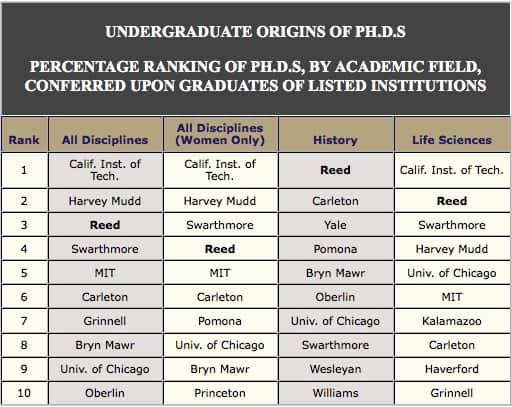
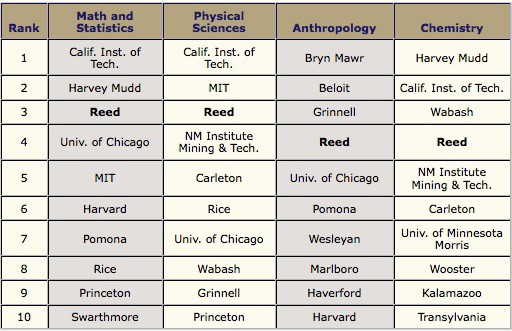
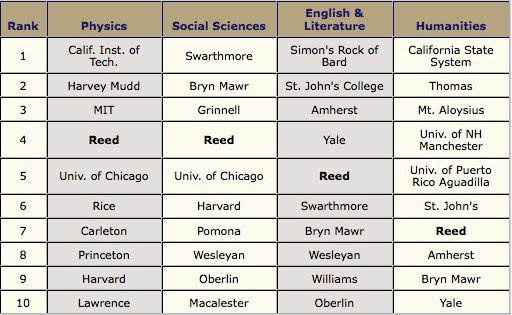
I realize that might be your reaction, but here’s the thing – many of the schools that are feeder institutions for the nation’s PhD programs are liberal arts colleges. While most liberal arts colleges are not well-known among families with teenagers, these institutions — and their reputations — are very well known to graduate schools. Lawrence University, a liberal arts college Appleton, WI, for instance, happens to be 10th on the list among all four-year colleges and universities that produce, per capita, the most physics PhDs. (See chart below.)

PhD Feeder Schools

I bet most families assume that attending a public flagship university or a nationally-known private research university is the best ticket to graduate school. If you look at the following lists of the most successful PhD feeder schools for different majors, you will see a somewhat different story. Not a single public university makes any of the lists. The entire Cal State system, however, is considered the No. 1 producer of humanities PhD’s.
I thought you’d be interested in the list of undergraduate institutions that, per capita, produce the most PhD’s. I pulled the names off the website of  Reed College, a liberal arts college in Portland, OR, that is understandably proud of its impressive record of turning out undergrads who end up earning PhD’s. The statistics cover the years 1997 to 2006 and come from the National Science Foundation and the federal government’s education database.
On the list of schools that have the most undergrads who ultimately earn a PhD  in all disciplines, Reed comes in No. 3 behind Cal Tech and Harvey Mudd College.
As you’ll see in the first column below, seven of the 10 schools, whose graduates earn the most PhD’s by the percentage of students are liberal arts colleges.


Bottom Line:

Students can increase their odds of being accepted to graduate school if they earn their bachelor’s degree at a liberal arts college. On a per capita basis, for instance, liberal arts colleges produce twice as many students who earn a PhD in science than other institutions. That makes sense since students have more opportunities to work closely with their professors, they can actually learn more due to small classes and receive glowing recommendations from their teachers, many of which, graduated from prestigious graduate programs.
What’s even more remarkable about the prominence of liberal arts colleges on the science lists is this: many students major in other disciplines at liberal colleges while students who attend schools like Cal Tech and MIT overwhelmingly expect to pursue careers in the sciences and engineering.
I’ve attached a lengthy essay by Thomas R. Cech, a Grinnell College grad, Nobel Laureate and chemistry professor at the University of Colorado, who wrote a fascinating essay contrasting the science experience for undergrads at colleges versus universities. Cech believes science majors at liberal arts colleges enjoy an advantage over undergrads who attend universities. Here are Cech’s thoughts:  Science at Liberal Arts Colleges: A Better Education?
Lynn O’Shaughnessy is the author of The College Solution, an Amazon bestseller, and a workbook,Shrinking the Cost of College. 

collegesolutions.com, Jan 2012

 *** Ace! is a member of the EducationUSA global educational advising network affiliated with the Bureau of Educational and Cultural Affairs, U.S. Department of State. We provide free EducationUSA counseling services to students in the northern provinces of Thailand; our faculty of U.S.-trained Test Prep Experts can help you with cost-effective result-driven training programs for SAT-1, SAT-2, TOEFL, GRE, GMAT, GED, AP, IB, TOEIC, IELTS etc http://acethai.weebly.com ***